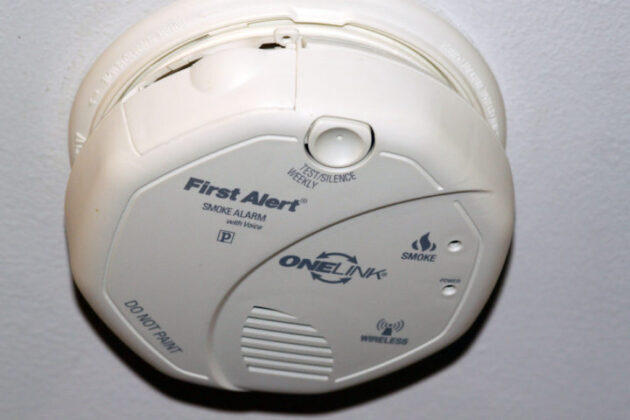
They say that Ionization smoke detectors don’t work as well as Photoelectric smoke detectors.
Who knew?
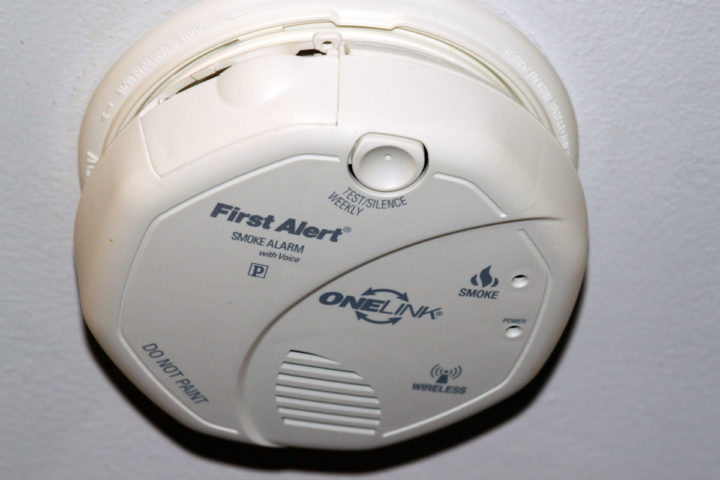
In fact, I didn’t realize there was even a difference in smoke detectors. I just figured a smoke detector is a smoke detector. But no…
Tests conducted by WTHR, local fire departments, university researchers and government scientists all show that in some slow burning fires, Ionization smoke alarms do not sound at all. Source
The sad truth is… with an Ionization smoke detector, you are more likely to die of smoke inhalation in a fire than you are if you had a Photoelectric smoke detector.
Okay then, what’s the real difference between Photoelectric and Ionization smoke detectors? And how can you tell which one you have?
Ionization vs Photoelectric Smoke Detectors
News Channel 5 here in Nashville ran a special on smoke detectors last week, and talk about eye-opening!
The biggest difference between these 2 types of smoke detectors is this:
A Photo-electric smoke detector doesn’t have a “nuisance alarm” that goes off whenever you’re cooking
whereas…
So if you’ve ever had the smoke detector in your home go off whenever you were cooking, then that’s your first sign that you probably have an Ionization smoke detector — which is better than no detector at all, but nowhere near as good as Photoelectric smoke detectors.
What To Look For
You’ll want to look for these things on the back (or on the front) of your smoke detector.
Ionization smoke detectors have…
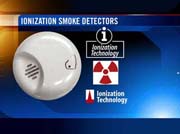
- a lower case letter “i”
- the phrase “contains radioactive material”
- a “fan-looking” symbol
- typically priced between $5 to $15
- The biggest drawback is they don’t pick up large particles of smoke as well as Photoelectric smoke detectors do. They pick up all those small particles (…like those contained in non-fire-related smoke when you’re cooking).
An Ionization smoke detector is only going to protect you from some of the kinds of fires you’re going to have in your house,” he said. “If you have a smoldering fire in your house, it’s not going to do anything for you. You can have a room full of smoke where you can’t see your hand in front of your face and the things won’t make a sound. — Jay Fleming, Boston’s deputy fire chief
Photoelectric smoke detectors have…
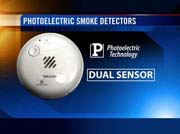
- a capital letter “P”
- the phrase “photoelectric technology
- makes reference to a “dual sensor”
- typically priced between $11 to $20
- Seeing a statement similar to this: “good for kitchens, bathrooms & living rooms” is a clue that yours is not an ionization smoke detector because Photoelectric detectors don’t have that “nuisance alarm” that typically goes off in those situations.
Summary
I got the impression from this news report that no one has really been talking about the fact that Ionization smoke detectors don’t always go off — even if the batteries are fresh and the detector itself is in good working order. Therein lies the tragedy.
In fact, a number of families have won lawsuits against the makers of Ionization smoke detectors simply because of the fact that the detectors did NOT go off, and lives were lost due to smoke inhalation.
Here’s yet another reason to toss the old Ionization smoke detectors in your home: After 10 years, the sensitive material inside the detector itself that recognizes radioactive materials during a fire degrades so badly that the detector must be replaced altogether.
Good News: Pending Legislation
There is currently a push to create new legislation requiring that Photoelectric smoke detectors be used in new construction and be more readily available on store shelves. This effort is being led by Boston deputy fire chief Jay Fleming.
Here’s a list of state-by-state residential smoke alarm requirements.
Until then, we can all do our part to switch out the Ionization smoke detectors in our homes and replace them with Photoelectric ones.
And perhaps a “random act of kindness” is in order… If you know of someone who might have an Ionization smoke detector, checking it out for them (and helping them replace it if they do) could save a life!
UPDATE: ABC News recently ran a story on Good Morning America on this same topic. See what the latest findings are with regard to ionization alarms, photoelectric alarms, and combination alarms.
More About Smoke Alarms
- View the Complete Story from News Channel 5
- Smoke Detectors Leave Victims Trapped By Smoke
- Smoke Alarm Controversy: What The Experts Are Saying
- So, How Do Smoke Detectors Work & Which One Is Best?
- What You Really Need To Know About Smoke Detectors
- Unfortunately, Kids Can Sleep Through Smoke Alarms
Don’t miss this video!… Will A Smoke Detector Wake Your Kids? If you have children, you must watch this report from NBC’s Today Show. It proves that even when kids have been trained what to do if they hear the smoke alarm, they probably won’t awake from their deep sleep in the first place.

I like to help people find unique ways to do things that will save time & money — so I write about “outside the box” Household Tips and Life Hacks that most wouldn’t think of. I’m super-organized. And I LOVE to clean! I even enjoy doing laundry (but not ironing). I’m also a lifelong dog owner — so I often share my favorite tips for living with dogs inside your home (like smart home design choices and dog-friendly cleaning & decorating ideas). Career-wise, I’ve been sharing my best ideas with others by blogging full-time since 1998 (the same year that Google started… and before the days of Facebook and YouTube). Prior to that, I worked in Higher Ed over 10 years before switching gears to pursue activities that I’m truly passionate about instead. For example, I’ve worked at a vet, in a photo lab, and at a zoo — to name a few. I enjoy the outdoors via bicycle, motorcycle, Jeep, or RV. When I’m not cleaning, organizing, decorating, or fixing something… you’ll find me at the corner of Good News & Fun Times as publisher of The Fun Times Guide (32 fun & helpful websites). To date, I’ve personally written over 200 articles about cleaning, organization, DIY repairs, and household hacks on this site! A few have over 2M shares; many others have over 100K shares.