Salt Water Systems vs Chlorine In Swimming Pools
We don't have a pool, but we DID!
Er, well we actually rented a house in Pensacola, Florida for a year that did.
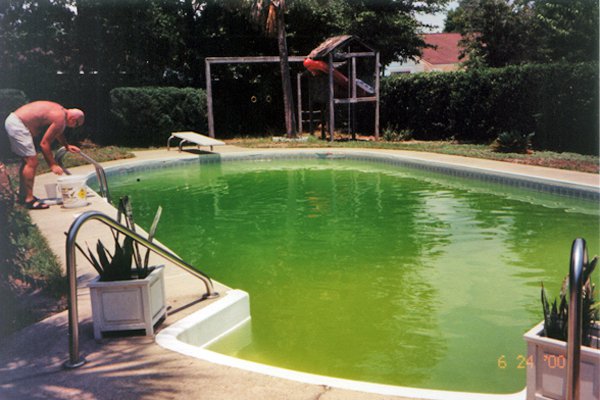
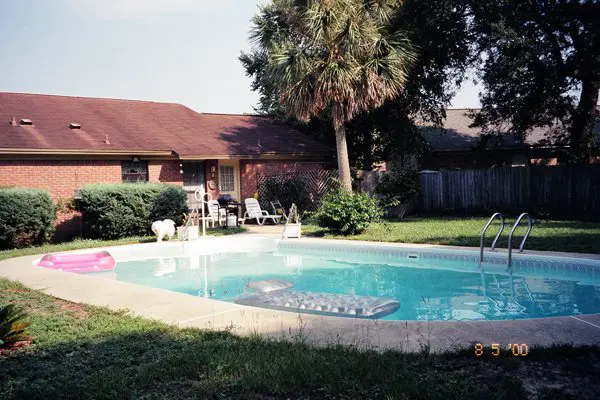
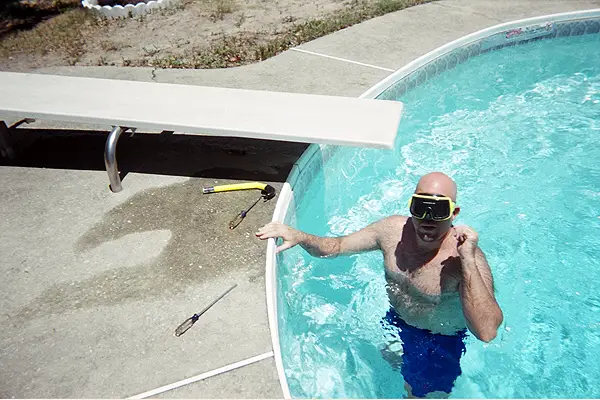
It was a full-size in-the-ground swimming pool -- with a diving board, a deep end, and everything! We were so thrilled.
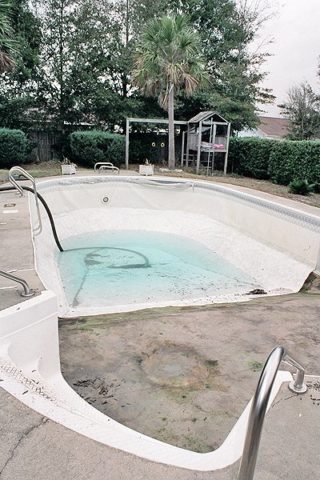
That is, until the liner along the inside of the pool started sagging, and the cleaners and filters quit working altogether.
The result: A limy green moss-filled swimming pool.
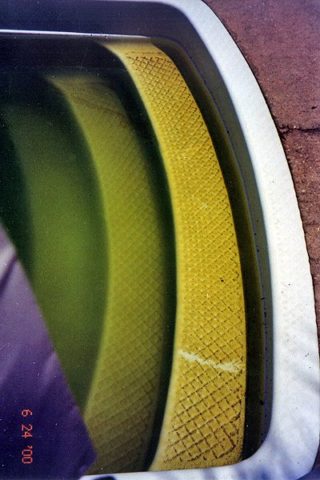
...This stuff practically grew overNIGHT!
How'd It Get So Bad?
Unfortunately, since dialog with our landlord (who lived out of town, but planned to move back into the house at a later date) was hit-and-miss at best, it took a few months to actually get the liner repaired and the chemicals regulated back to normal.
The landlord had given the "pool boy" who regulated all the chemicals some time off until the liner could be repaired, so Jim and I took it upon ourselves to purchase the proper chemicals for the water -- just so we could get a few more weeks of enjoyment out of this pool. After all, it was the main reason that we chose to rent this house in the first place!
As a result, we are somewhat familiar with pool chlorination and filtering procedures... which is what makes the following information so interesting.
Salt Chlorinators For Swimming Pools
Did you know that there's a way to "chlorinate" your swimming pool without all the harsh effects of chlorine -- like red, irritated eyes and itchy skin?
The answer is a salt-water system!
No, it doesn't turn your swimming pool into the Atlantic Ocean. Nor does it make you feel like a seasoned salad after swimming in it. It simply gives you all of the benefits of traditional chlorinated water, without the negative side effects.
- No red, burning eyes
- No itchy skin
- No harsh pool chemicals (like chlorine or algaecides) to buy
In sum, with a salt-chlorinator, pool maintenance is easier, so you're able to keep your swimming pool looking great with much less hassle.
Too cool.
If I had a pool, I'd seriously consider salt-chlorination...
UPDATE: The following appeared in the 2007 edition of Landscape Solutions (I think it's a Better Homes & Garden specialty magazine):
By choosing a saltwater sanitizing system, you can reap the benefits of traditional chlorinated water without many of the negative side effects.
#1 It's more comfortable. Salt softens pool water so it's gentler and less likely to cause red, burning eyes or dry, itchy skin.
#2 It's easier on swimwear. Fabric swimwear won't fade or disintegrate over time.
#3 It smells better. Lower chlorine levels eliminate chlorine taste and smell. The water tastes slightly salty instead.
#4 It inhibits algae naturally.
#5 It's safer around kids and pets. Saltwater pools reduce the need to purchase, store, add, and handle chlorine, but salt can be corrosive over time.
#6 It saves time. Saltwater systems are easy to maintain once the system is learned.
#7 It's cost-effective. Saltwater systems are more expensive initially but less costly over time.
UPDATE:
More about salt water pool systems Salt Water Pool Systems: Facts From A Pool Expert
More about salt water pool systems
They stop working at about 55 degrees water temp I believe.
I plan to keep my saltwater pool open this winter. Should I keep the salt levels up all winter? At what temperature does the turbo cell stop converting the salt to chlorine?
We have an intex saltwater system and it is cheap and easy. However, this summer we have been having some trouble with the pH and alkalinity being too low and the salt water system's booklet does not tell you how to resolve the problems. I called their 800# and their recording says to consult your local pool supply store. Well, our local store knows nothing about salt water systems. They recommended adding 3 different things to the pool, but I don't want to ruin the salt water system. Any advice?
Salt systems DO NOT cause your equipment or your pool to last any less than normal as long as you keep your salt in the normal working level. This is a salt level of less than 3200, A salt level higher than this will make many systems not work due to a High Salt error. BUT, a salt level more than 3850 can cause errosion of many items such as concrete metel and even plastics. There are a few system that do not have a high salt error and can work in salt level over 4500 .
NO one here has said anything about the pool phosphates which can directly cause CHLORIMINES in a salt or normal pool which will cause algae and PH problems along with increased chemical usage. WE HANDLE a few Swim-schools and until we kept the phosphates out of the water it was a nightmare to keep the kids eyes from burning even know it is a salt system. (PHOSPHATES COME FROM MANY THINGS NOT JUST LEAVES AND URINE)You should check into that.. Also another problem is many systems are designed to work under a limited range of conditions. Such as PH from 7.2 to 7.8/ stabilizer at 80-100/ alkalinity at 90-120/ and salt between 2700-3200/ temp above 60 deg. (AS PER THE AUTO.... REPAIR TECHS) AND if these are not kept right they just shut down.. IF you are getting a new salt system check on the operating conditions it will work in, There are a few systems that will keep your pool good no matter what else is wrong.
Hey if you have a regular pool that doesnt take salt. I normally but about 4 gallons of chlorine and shock the pool and about 1 galon of muradic acid and brush the whole pool and keep brushing it daily and make sure you run your pool and i guarantee it will clear up.
Regard's
Dustin
http://www.semoweb.com
We also have gas lines running behind our property (within 50 feet of the pool). Our pool is chlorine and we have never in 14 years had an electric shock problem.
I'm not sure what kind of climate you live in but here in the south where it's hot and humid a salt pool needs much more than just salt. I talk to a lot of homeowners who say I have salt so I just throw in salt and I'm good. But the pool will turn green if you don't shock once in a while, that may be once a week or every two weeks in hot weather. It also can be harder to balance the pH and alkilinity as well. You also still need stabilizer. Keep in mind that the salt cell uses salt to make a chlorine gas and release it into your pool, the only benefit I see of a salt pool is that it may soften the water and some people like the feel of the water better but it often does not disinfect to the level it needs to otherwise we wouldn't be shocking salt pools. The corrosion levels of equipment and natural stone around the pool is also a problem with salt.
I bought a saltwater chlorinator for my intex pool my water was nice and clear, I had just filled the pool. I ran the system the recommened time,it turned my water green.Not sure what I need to do.
Thank you for the information. Can you give me some idea as to the process of converting from the ever so expensive Bacquacil to Chlorine? Also, once the conversion takes place, is there a substantial difference in chlorine products? If we start with one chlorine product and then add another chlorine based product will the pool water react negatively to the different brands. I suppose what I am trying to ask is: Are chlorine product consistent in their production process?
Hello Folks,
Thanks for the interesting comments about salt versus chlorine.
I am considering putting a small in-ground pool in my yard. I have 2 problems:
One: The pool guy told me to go with salt to save me money per month. I am not sure about this and I am glad that I read the information that is on this site.
Two: My backyard is small but my neighbors can look right in. Can you suggest some type of trees that I can place so that there are trees in front of the pool and the windows?
Thank you,
Mike
I have an in-ground chlorine pool. When I first bought my house in 2000, the pool was in disrepair, so I bought new equipment and had it resurfaced. To date, I have had no problems with the chlorine pool. I never really thought about changing to a salt-water pool until I heard some of the other firemen I work with that have them and say how great they are. So I considered adding a salt-water system. When I asked my pool guy about them (who I feel is very honest with me), he advised me not to get one as the pools he's serviced are not as easy to maintain. He was telling me stuff like calcium build-up, cell replacement, properly maintaining the pH levels, and the list goes on. He said that chlorine-based pools have been around so long, and they are still the most reliable. He also told me that the way I like to keep my pool warm in the summer (I have solar, and I like the pool at least 90 degrees), it would be even more difficult to keep balanced. After reading these articles and others on other websites this morning, I have decided to keep my old-reliable chlorine pool. I never have had the red eye, smelled like chlorine, eye-burning, etc. I think it's all a bunch of hype and extra expense for very little gained.
i'm thinking about installing an in-ground pool, but after readin all the comments, i'm not so sure if i still want to do it or not.. every1 been having all kinds of problems with both salt water and chlorine pools..wow..
Hi Maggie,
Baquacil has caused a lot of problems for people from what I've read on line. I guess it's a hydrogen peroxide product which is not the greatest because it wouldn't last the way chlorine does, therefore people have algae problems...not sure how it worked for you, but I guess that's beside the point.
Salt pools vs chlorine pools don't have that much difference in price. As a service company, I don't know about your area but here in Plano, TX...I see more problems with salt then benefits. The pools that are salt tend to have so much more corrossion problems, you still have to shock them (meaning you still use chlorine), things just seem to wear out faster. Here'e the other expense we clean the salt cell every 3 months, and if it goes out it's expensive to replace it. The $600 you spent is a lot for one pool especially if you live in a seasonal place. Some studies have shown salt and chlorine pools to be almost the same cost. It is harder to control the pH in a salt pool, many things you need to watch. I personally find that most people like a well-balanced chlorine pool. I have clients that are completely in love with salt and some that switched back to chlorine to stop the corrossion. Personally I think salt will cost you a bit more than chlorine overall but they should be pretty close. The key is to keep either one totally balanced, make sure you watch the pH and alkilinity, keep your filter cleanings on a regular basis, if you do salt clean the salt cell every 3 months, it won't work in the winter so if you keep your pool open you need to use chlorine anyway. And when it's hot you still use shock. The only benefit might be softer water and some people notice it and some don't. Again climate and water quality where you are might make a difference.
We are considering installing a salt based system in our swimming pool because Baquacil is far to expensive for two retirees. We figured the cost of conversion is about $1,000 however we spent $615 in B/chemicals last year and we have a 18 x 38 in-ground pool. What has been the cost of salt-system chemicals during a normal season? Can we install the system ourselves? Seems like a lot of pros and cons for the salt system. Compared to B/chemicals what is the saving of salt each season for a comparable pool to ours?
Larry asked earier about corrosion to the concrete deck and other parts. Salt is very corrosive and the biggest problem is with natural stone. The builder/remodeler that I work with will not install a salt system with a natural stone waterfall or coping which I agree with. It might depend on the type of concrete you have but I personally would go with a well balanced chlorine pool, remember the salt cell generates chlorine. Notice in the comments that people still use shock on the salt pool, that's high concentration of guess what? Chlorine! There was also a discussion about a natural system I think that is a good way to go too, I just don't know a lot about it. But salt can be more trouble than it's worth. And does it corrode other parts of your equipment? I believe yes.
http://www.texasoasispoolservice.com.
Many of the previous comments are true a salt cell is not easier or that much less expensive to maintain. pH and alkalinity will be more difficult to maintain, you will also need higher levels of stabilizer to hold a chlorine level. Remember your just using salt to generate chlorine it's still technically a chlorine pool. Your only benefit will be softer water if you can tell and are maintaining it properly. Out of our clients 4 out of 5 choose not to replace the salt cell when it goes out (it can be expensive to replace). As a pool maintenence company I have no preference but I can see that most of my clients find the salt to be corrosive to their pool environment and not really worth the hype. Also what some have said about burning and iching of chlorine pools is not true in a properly balanced pool. There is no reason to have a smell, buring eyes or any of that in a properly maintained pool. If you smell chlorine as often happens in public pools it's because of urine and other contaminates in the water that are not being taken care of. Bottom line - whether you choose salt or non-salt you must have perfectly balanced chemisty and you'll be happy with either one. You can't just say I've thrown in tabs I'm good, or I've put in salt I'm good. Also salt pools do not work in water temps under 55 degrees so in winter you might as well turn them off. Always consider the chemistry which is typically knowing your acids and bases! http://www.texasoasispoolservice.com
The financial cost is about $1000. The cost in time and frustration is priceless. Avoid salt. They are NOT low maintenance and if you have problems getting your chemicals just right with ordinary chlorination, your trouble will be much greater with salt, as the generators are a chemical reactor that is very sensitive to levels of stabilizer, pH and others. I am so happy I gave up on my saltwater and reverted to nice and easy tablets.
I HAVE A ABOVE GROUND CHEMICAL POOL..DOES ANYONE KNOW THE COST TO CONVERT TO THE SALTWATER POOL SYSTEM...THANKS DEBBIE
I love my salt water pool. We installed it in April 2008. It has been easy to maintain. Of course, since it's new, I have had no maintainance costs, yet. I have no problems with algea. The only problem I have is a slight electric shock. I have since found out it is because I have 3 gas pipe lines that run within 50 feet of my pool. It would happen whether it was salt or chlorine. The gas lines have an electric current that runs though the pipe to eliminate corrosion in the pipes.
I'm glad I read all the comments. I was considering putting in one of these systems. Doesn't really seem to be worth the hassle.
I have a Hayward goldline aqualogic saltwater chlorination system. It is a HASSLE to maintain compared to dropping some chlorine tablets in once and a while. Unless your pH is just right all the time, the system is very finiky. AND ABOVE ALL ELSE, after only a few year (well past the measly 1 yr warranty) THE VERY EXPENSIVE SYSTEM has stopped working and the serviceman and Hayward as well said I will have to buy a new circuit board for over $600.
I DO NOT RECOMMMEND THIS SYSTEM OR ANY SALTWATER SYSTEM, the "low maintenence" is a sales pitch, the water does not feel any better, and the intial and repair costs are outrageous. After fussing for so long with maintaining perfect pH and other levels just so that this thing keeps chlorinating, having to add gallons of acid regularly, and having to take apart the system to clean the electrolytic cell monthly, I am happy it died. Now I can just enjoy my pool like my neighbors do theirs, and easily putting some tablets in a floater once a week.
We installed a Clear Water LM3 3 years ago and though we love the saltwater chlorinator we've had nothing but problems with it. Our hard water level is very high and though the rest of the pool is perfectly balanced the LM3 will clog up and not produce chlorine every week unless it's cleaned. Believe it or not the LM in the name stands for low maintenance. That's a joke and so is their support which is nill to nothing. We've tried every thing and their is so much confusion in the info about maintaining a saltwater pool this way that it will drive you nuts. Perhaps there are others out there with better luck but would stay away from the Zodiac Clearwater units.
We installed a new in-ground pool with a salt system and are experiencing the same electrical shock when touching the side of the pool. We also feel it when we step out of the pool using the steps or the ladder. I was wondering if something had been installed incorrectly. The person who installed it said it was associated with the salt system, but I would like to get a second opinion.
i have a 1986 vinyl 18 by 36 dept 8 ft. pool. i have always had problems with the liner and keeping the chemicals correct. i always get some type of green algae dust. i go to the pool store on a regular basis with water samples and follow instructions. i am interested in the salt water change over. please give me step by step on what i need to do and approximately cost.
It was explained to us that salt water conducts electricity better than fresh water and that women and children typically notice the little electrical Zap more than men due to supposed "thicker skin" (?!?)...
Here is an eco-friendly and cost effective pool product that contains NO Chlorine! It is called My Natural Pool and you can obtain information at http://www.mynaturalpool.com and if you are after other eco-friendly or health oriented products you will also want to bookmark http://www.excellentnature.net.
Salt water pools are contaminating our waterways and counties in California have begun banning salt water pools with penalties of up to one year in prison and $1,000 fines. They are doing this since the backwashing of pools generally runs into our water municipalities and after treatment that water is then generally returned to the local rivers and streams. So with less then 2% of Earth's water being fresh drinking water we are contaminating our fresh water resources with salt water, not a good idea for humans or the environment. Increasing salinity of our inland waterways also has a negative effect on our eco-systems and wildlife.
BTW, I find most people are unaware that a salt water pool is still a Chlorinated pool. The by-products of Chlorine are PCB's and PBB's two of the deadliest compounds known to man.
If you own a pool please do your family and our global environment a favor and use products that do not contain Chlorine.
Thank you!
Andrew Tait
Managing Director
The Environmental Community
I am having the same problem. So far I have found no solution to the problem. Hopefully someone will have some suggestions.
we have an above ground and are looking into getting an in ground not sure which salt or chlorine...do you know around about how much either will cost to install. we dont want a large pool just enoug for a fam of 4. thanks
We have just switched over to the salt system and now are experiencing an electrical shock when touching the top rail around the pool (even with the electricity off). Does this have something to do with the salt system?
I have a 35,000 gallon negative edge salt water pool with blue plaster walls/floor and absolutely love it. The only problem I'm having is the amount of shock I have to use after a big party or just in the normal course of swimming. I'm currently using RAM Litho Shock as it was recommended because it will not stain my colored walls/floor as is a concern with other shock treatments, BUT it takes 1 1b. of shock per 10,000 gallons. That means I get about 5 shock treatments out of a 15 lb. $80 bucket of shock. That seems a little high to me, so I'm wondering if there are other more concentrated shock treatments that won't discolor or bleach my plaster that don't use 3.5 pounds to adequately shock my pool. Does anyone have any suggestions? BUT the most important thing is to not stain/bleach the bottom.
Thank you,
Hello-I have an inground chemical pool. We are considering conversion to salt water. Di I need to change/replace my existing pump,filter and/or heater system. Will salt water erode or affect the pool surface or surrounding concrete decking and drain systems ???
Salt water pools are a more natural way to keep your pool clean while maintaining a chemical free swimming environment. I enjoy swimming in a salt water pool so much more than any chlorine pool. Thanks for the article!
Hi Jill,
Using a salt water pool system actually generates chlorine. So it is possible it could hurt the fish and the micro ecosystem around you.
Does anyone know what effect it has on the environment? We live near the water and want to know if the tide is high and the pool overflows, will it harm the fish and such?
The problem with salt water pools is that they do cause damage to your pool equipment, liner, and stonework.
1.Mass acceptance of salt chlorine generation happened 20 years ago in Australia,where i am living.
2.Over 90% of pools have salt chlorination systems.
3.New generation 3 electrolytic cells like the Mirrakel have extremely long cell life.
4.Dangerous Trichloramines are effectively converted in the cell by the high cell concentrations of chlorine and electrical energy.
5.Pool Stores in Australia effectively started discrediting the technology initially [ reduced sales of chlorine and self interest],but now sell pool salt instead.
6.The smell that is often attributed to chlorine is actually chloramines,and salt water systems do not appear to have that problem.
7.The one drawback appears to be the salt ingress into soft paving stones [like sandstones],this can be alleviated by application of a sealing compund over the stone.
8. For those with salt water pools,welcome to the revolution.
Everyone says that eye irritation from pools is caused by a ph imbalance. So why don't you get that with saltwater pools? Don't they sometimes have ph imbalances?
I have an above pool, 15ft. round. the chloring turns the water brown, because of the well waters heavey iron content. Will the salt water system also turn the water brown? Help I am desperate!
As a pool service provider i have found that the cost of a salt water set up is twice as much in the long run as having a chlorinating system. yes your not putting in chlorine tabs, but you still need to ozidixe your pool. Using the super chlorinate switch only shortens the life of your cell. another known factor is the a salt cell does not work in weather below 55 - 60. it is damaging to the cell to run it in low temp winters. thus haveing to use chlorine agian.
When it comes time to replace parts the cost on the salt cell is up around 5-$600 hundred where as a new chlorinator is around $70. This is where you get the expence in a salt water pool vs having a chlorinator.
as far as the red eye this is a factor of ph off ballance.
In the end a salt cell creates chlorine so no matter how you go your still going to have a chlorine pool. its a matter of carrying a couple 3oz tabs to a chlorinater or a 40lb bag of salt to the pool.
All and All i hope this little bit helps.
we just got a salt water system last year,and it's great the only thing is to make sure that you have someone that knows the system and how it work alot of the pool stpres around us did not no, or did not deal with that kind of system. i did find someone in the philadelphia area and it;s the best thing i have done
We are looking to put a pool in and are trying to decide if we should go with a salt system or use regular chlorine, we have had a pool before and using regular chlorine was very easy and simple, not rocket science for sure, if salt is easier I am for it but is it really??
can anyone help?
I work for a company that manufactures salt water chlorinators and we have done extensive testing of our products to make sure nothing bad happens from them. The corrosion James is talking about is not caused by salt. It's caused by incorrect water chemical balance.
The skin and eye irritation is caused by chloramines (dead chlorine). When the water passes through chlorinator electrodes the chloramines are broken up by electric charge, that's why there is no smell of chlorine and no skin or eye irritation. Also another factor is that with salt water chlorinators you don't get all the by-product chemicals which are contained in liquid or tablet chlorine.
I work in a pool store, and I have experienced nothing but problems with Salt pools. They are highly corrosive and still need to have their water balanced on a regular basis. Also red eye and skin irratation are not caused by chlorine, they are caused by PH, if chorline caused that than a Salt pool would still make you itchy and have red eye.
we are considering a Salt system, but have heard you have to resurface the pool every few years due to the salt. Does anyone have any info on that?
My parents in SC have been operating their pool with a salt-based system for quite a few years and it has saved them tons of money in the long run. I liked it so much that I was able to convince our HOA members to switch to a salt system. Everyone had a hard time believing what I was telling them about the system but they quickly became believers once they saw it in action. Big bonus: Our HOA is voluntary so it is perpetually cash-strapped. This switch in chlorination systems SAVED BIG $$$ for the neighborhood. I would never go with any other system if I had a pool myself.
My dad used to have a pool. It was an above ground pool, but they dug into the ground to make the deep end. (if that makes any sense!) Anyway, he had to replace the liner at least twice and they are pretty expensive and combine that with the chemicals that you have to use, it just got too pricey for him. So, he turned it into a pond...lol. It looks kinda dumb though. I wish that we had known about the salt pools. Maybe that would have made a difference?